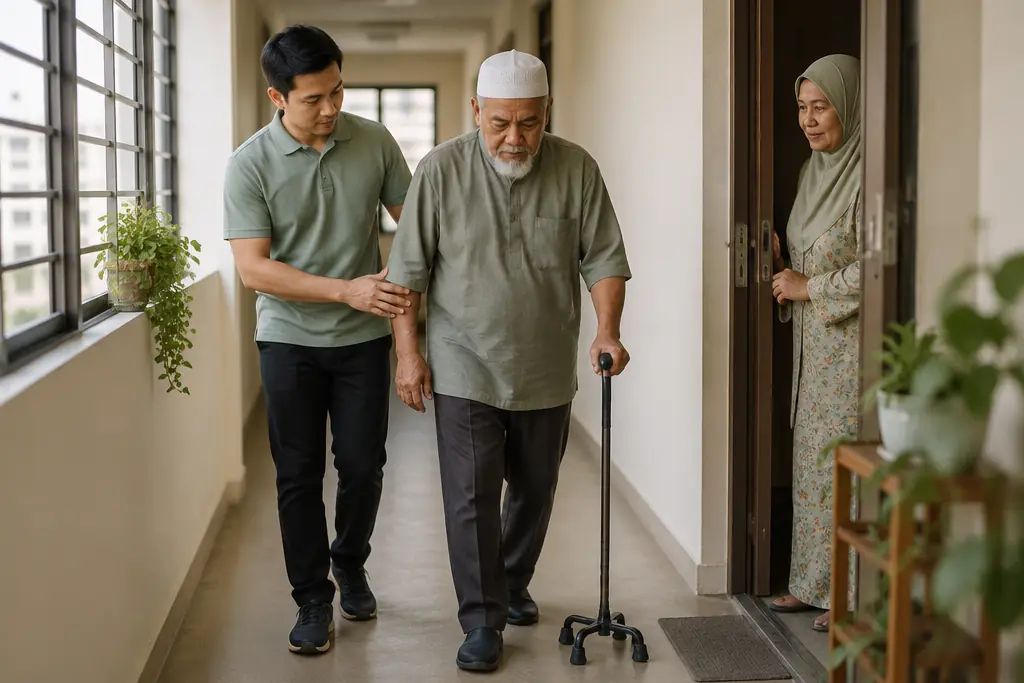
How home physiotherapy can help
- Practising getting up, walking and moving around your own home
- Balance and steps, with attention to falls at home
- Using a weaker arm or leg in everyday tasks
- Showing family members and helpers how to support safely
- Advice on walking aids and how the home is set up
Your physiotherapist decides what is right for you after assessing you.
What physiotherapy after a stroke works on
After a stroke, physiotherapy focuses on helping you move safely again and on preventing problems such as stiff muscles and joints. Practice matters because the brain can reorganise itself and form new connections, which is how many people regain movement over time.1
At home, your physiotherapist works on the movements your day actually needs. For example:
- getting in and out of bed, and standing up from a chair
- walking around your home, with or without a walking aid
- steps, thresholds and getting into the bathroom safely
- using a weaker arm or hand in everyday tasks
- balance, so you feel steadier on your feet.
Practising between visits
Progress usually comes from regular practice, not just the hour your physiotherapist is there. HealthHub’s guidance is to practise every day, or at least three times a week, ideally at a regular time each day, and to build activity up gradually, especially if you feel tired after the stroke.1
Your physiotherapist leaves you with exercises that suit you and checks them at the next visit.
How family members and helpers can help
Family members and helpers make a real difference. HealthHub recommends that caregivers attend rehabilitation sessions and learn how to help with exercises at home.1 Your physiotherapist can show them how to:
- help you stand, walk and transfer safely without straining themselves
- support your exercises between visits
- spot when something is too much and you need to rest.
Other support after a stroke
Physiotherapy is one part of recovery. Depending on your needs, your doctor or physiotherapist may suggest occupational therapy (everyday tasks such as dressing and bathing) or speech therapy (speaking and swallowing).2 Oreka arranges physiotherapy only, but your physiotherapist can tell you when another kind of therapy might help.
Support groups such as the Singapore National Stroke Association and Stroke Support Station run activities and groups for stroke survivors and families.
What a home visit involves
Each visit is 60 minutes at home, starting on the hour. At the first visit, your physiotherapist asks about your health and goals, sees how you move, and agrees a plan with you. Initial and follow-up visits cost the same.
Questions
When can home physiotherapy start after a stroke?
When the patient’s doctor or hospital team is happy for them to be at home and active. Oreka checks suitability on the call, and the physiotherapist assesses at the first visit whether home physiotherapy suits them now.
Can family members or a helper join the sessions?
Yes. Your physiotherapist can show them how to help with exercises and with moving safely between visits.
How often should someone have home physiotherapy after a stroke?
Your physiotherapist recommends how often to visit after the first assessment, based on your goals and how you are recovering. Between visits, regular practice of the exercises they leave with you matters as much as the visits themselves.
Can home physiotherapy continue after hospital or day rehabilitation ends?
Yes. Many people continue physiotherapy at home after hospital or centre-based rehabilitation. Bring any discharge summary or therapy notes you have: they help your physiotherapist pick up where the last team left off.
Other care at home
- Neurological care
- Falls, frailty and feeling unsteady
- After surgery
- Muscle, joint and ongoing pain
- Swelling (lymphoedema)
- After heart treatment
- After a knee or hip replacement
- Back and neck pain
All home physiotherapy by condition
Sources
- HealthHub (Ministry of Health), Rehabilitation after Stroke: Physiotherapy, last reviewed 3 June 2026
- HealthHub, Rehabilitation after Stroke: Occupational Therapy, last reviewed 11 June 2026
- HealthHub, Rehabilitation after Stroke: Speech Therapy for Communication Difficulties, last reviewed 25 May 2026