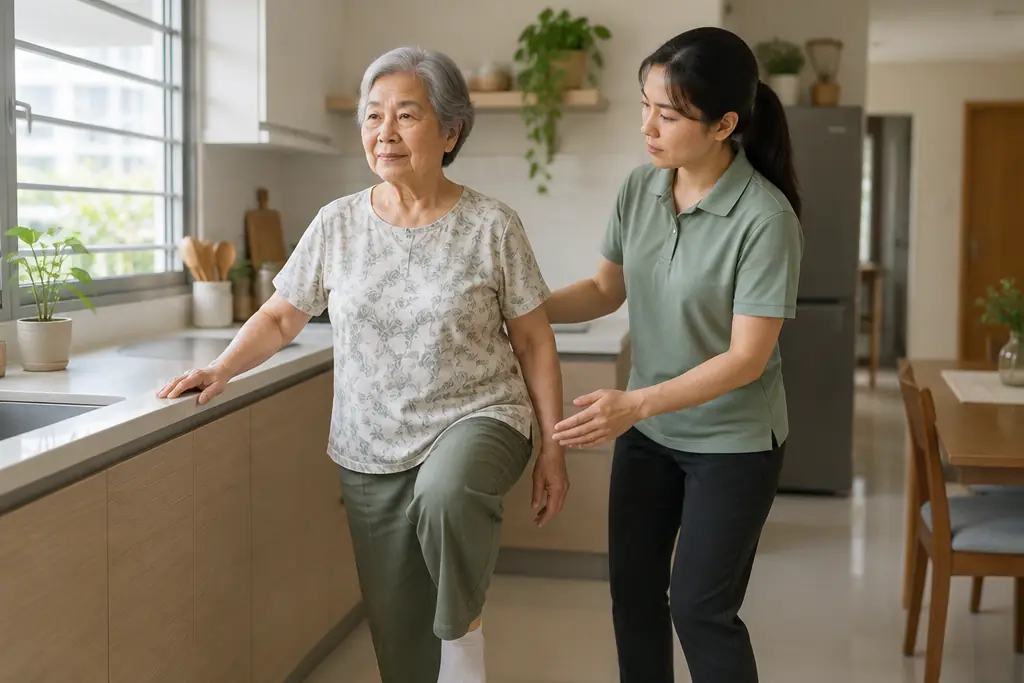
Falls are common. In Singapore, about one-third of people aged 60 and above have fallen more than once, and fall-related injuries happen mostly at home.1 Many of the things that make a fall more likely can be worked on, which is where physiotherapy at home helps.
How home physiotherapy can help
- Strength and balance exercises matched to the person
- Practising getting up from a chair, the bed or the floor
- Walking safely indoors, with a walking aid if needed
- Spotting trip hazards and awkward places at home
- Guidance for family members and helpers
Your physiotherapist decides what is right for you after assessing you.
What makes a fall more likely
The Health Promotion Board groups the risks into two kinds:1
Things about the person
- weaker legs, poorer balance or slower walking
- health conditions that affect vision or strength
- medicines that can make you feel unsteady
- not being very active, tiredness and poor nutrition
Things about the home
- slippery floors, especially in the bathroom
- loose rugs and trailing wires
- poor lighting, particularly at night
- unsuitable footwear or the wrong glasses
How a physiotherapist works on falls at home
At the first visit, your physiotherapist asks about any falls or near-misses, sees how you move around your home and agrees goals with you. Visits can then include:
- strength and balance exercises suited to you. HPB recommends strength, balance and flexibility exercises at least three days a week.1
- practising the risky moments: standing up, turning, walking to the toilet at night, steps and thresholds
- walking aids: whether one would help, and using it properly
- getting up after a fall: what to do, and how family members or a helper can help safely
- simple home changes, such as clearing walkways, better lighting and where grab bars would help.
Making the home safer
Small changes make a big difference. HPB suggests:1
- removing floor rugs, or using a non-slip backing
- coiling or taping cords and wires next to the wall
- keeping floors clear of clutter
- fixing loose or uneven steps
- grab bars and non-skid tape in the shower
- good lighting in entrances, stairways and rooms.
For HDB households, the Enhancement for Active Seniors (EASE) programme subsidises improvements such as grab bars and slip-resistant treatment for toilet and bathroom floors. A household qualifies if a family member is aged 65 or above, or 60 to 64 and needs help with daily activities. Check eligibility with HDB.2
Other checks worth doing
HPB also recommends regular reviews with your doctor, including eyesight and medicines, as part of preventing falls.1 Your physiotherapist may suggest this if something they see points to it.
What a home visit involves
Each visit is 60 minutes at home, starting on the hour. At the first visit, your physiotherapist asks about your health and goals, sees how you move, and agrees a plan with you. Initial and follow-up visits cost the same.
Questions
Is this suitable for someone who is frail or mostly at home?
Often, yes: the visit comes to them. Oreka checks suitability on the call, and the physiotherapist assesses what is safe at the first visit.
Do we need special equipment?
Usually not. Your physiotherapist works with what is at home and tells you if anything would help.
Can physiotherapy help if someone is afraid of falling again?
Yes. Fear of falling often makes people move less, which can make them weaker and more likely to fall. Your physiotherapist works on strength, balance and confidence step by step, in your own home.
Should a family member or helper be there for visits?
It often helps. Your physiotherapist can show them how to support walking and transfers safely, and what to do if a fall happens.
Other care at home
- Stroke recovery
- Neurological care
- After surgery
- Muscle, joint and ongoing pain
- Swelling (lymphoedema)
- After heart treatment
- After a knee or hip replacement
- Back and neck pain
All home physiotherapy by condition
Sources
- HealthHub (Health Promotion Board), Preventing Falls at Home, last reviewed 13 March 2023
- Housing & Development Board, Enhancement for Active Seniors (EASE), checked 1 October 2026